The Raote lab contributed to the publicaiton of a new article in PNAS :
A model for collagen secretion by intercompartmental continuities
Abstract: Newly synthesized secretory proteins are exported from the endoplasmic reticulum (ER) at specialized subcompartments called exit sites (ERES). Cargoes like procollagen are too large for export by the standard COPII-coated vesicle of 60…
The Balavoine Lab recently published a new article in Plos One:
Fast cycling culture of the annelid model Platynereis dumerilii
Abstract: Platynereis dumerilii, a marine annelid, is a model animal that has gained popularity in various fields such as developmental biology, biological rhythms, nervous system organization and physiology, behaviour, reproductive biology, and epigenetic regulation. The transparency of P. dumerilii tissues…
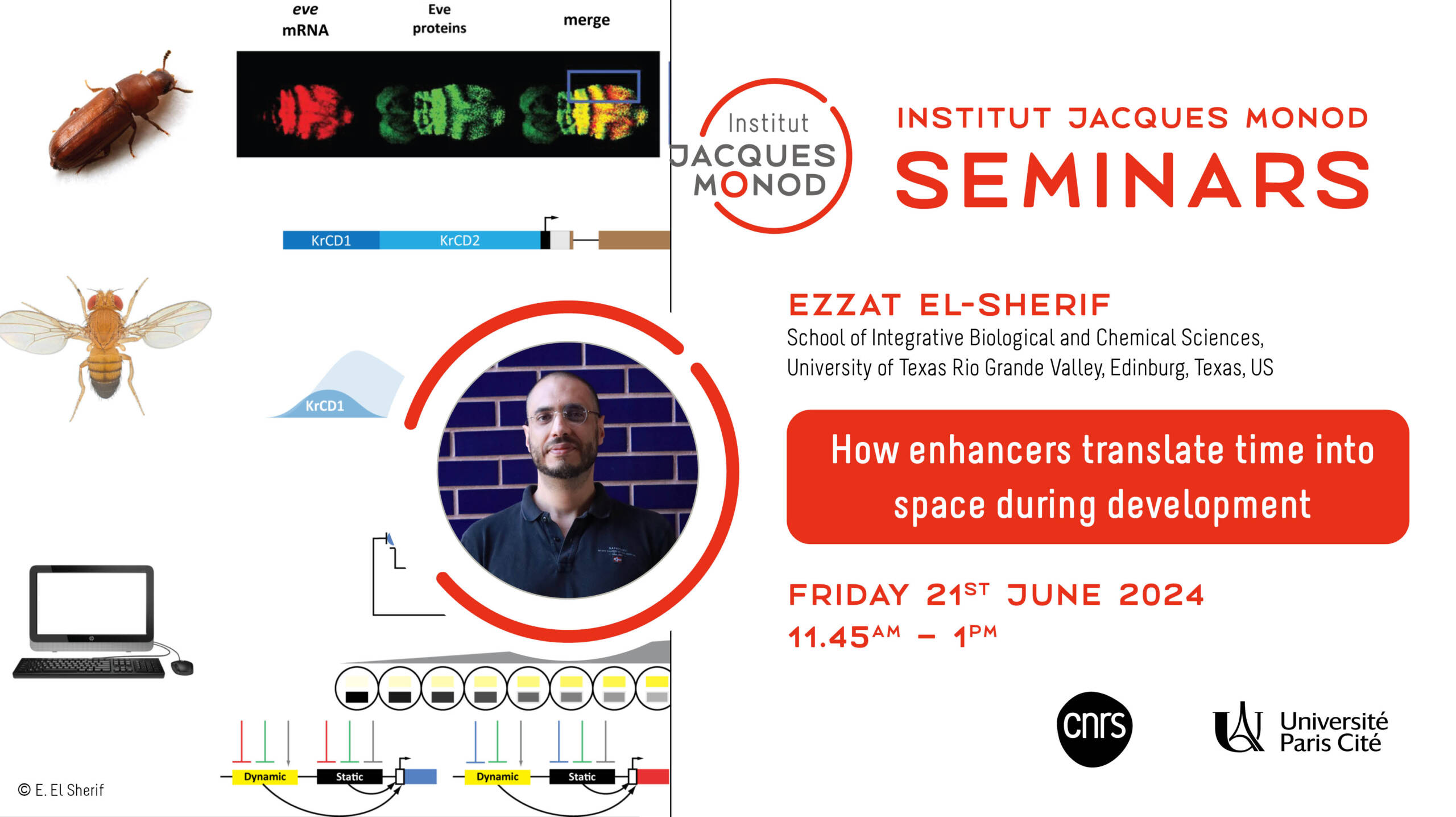
Invited by the Konstantinides Lab, Simon Sprecher (Faculty of Science and Medicine, University of Fribourg) will present an IJM seminar:
Mechanistic and evolutionary insights into the making and forgetting of memories
Abstract:
Plasticity of the brain with its ability to learn and form memories is one of the most astonishing features of the nervous system. We study…
Photo credit © Aude Nommick (Minc Lab)
The Ribes Lab published a new article in Emerging topics in life sciences:
Stem cell-derived models of spinal neurulation
Abstract:
This review is the fruit of an enriching collaboration with my thesis supervisors Vanessa Ribes and Stéphane Nedelec (Institut du Fer à Moulin), along with Martin Catala (Institut de Biologie Paris Seine) and Mikaëlle Bocel (Institut Jacques…
The Courtier lab recently published a new article in Plos one:
Recommended distances for physical distancing during COVID-19 pandemics reveal cultural connections between countries
Abstract:
During COVID-19 pandemic several public health measures were implemented by diverse countries to reduce the risk of COVID-19, including social distancing. Here we collected the minimal distance recommended by each country for…
The Léon lab contributed to a new article published in Molecular Cell:
Ubiquiton - An inducible, linkage-specific polyubiquitylation tool
Abstract:
The posttranslational modifier ubiquitin regulates most cellular processes. Its ability to form polymeric chains of distinct linkages is key to its diverse functionality. Yet, we still lack the experimental tools to induce linkage-specific polyubiquitylation of a protein…
Invited by par l'équipe Grange/Geigl, Catherine André (Institut de Génétique et développement de Rennes) will present the IJM seminar:
Spontaneous models of genetic diseases & cancers in dog breeds: interest to decipher the genetics of rare diseases
Dogs develop numerous genetic diseases, often breed-specific, due to the strong artificial selection applied by humans, likely for more…
The Camadro Lab published a new article in NAR Genomics & Bioinformatics:
3D models of fungal chromosomes to enhance visual integration of omics data
Abstract:
The functions of eukaryotic chromosomes and their spatial architecture in the nucleus are reciprocally dependent. Hi-C experiments are routinely used to study chromosome 3D organization by probing chromatin interactions. Standard representation of…
The Borghi Lab contributed to a new article published in Experimental Hematology & Oncology:
ProNGF promotes brain metastasis through TrkA/EphA2 induced Src activation in triple negative breast cancer cells
Abstract:
Background
Triple-Negative Breast Cancer is particularly aggressive, and its metastasis to the brain has a significant psychological impact on patients' quality of life, in addition to reducing…