L'équipe Camadro a récemment contribué à la publication d'un nouvel article dans Briefing in Bioinformatics :
The five pillars of computational reproducibility: bioinformatics and beyond
Résumé :
Computational reproducibility is a simple premise in theory, but is difficult to achieve in practice. Building upon past efforts and proposals to maximize reproducibility and rigor in bioinformatics, we present a…
L'équipe Courtier a récemment publié un nouvel article dans Current Opinion in Insect Science :
The loci of insect phenotypic evolution
Résumé :
Insects are important elements of terrestrial ecosystems because they pollinate plants, destroy crops, transmit diseases to livestock and humans, and are important components of food chains. Here, I used Gephebase, a manually curated database…
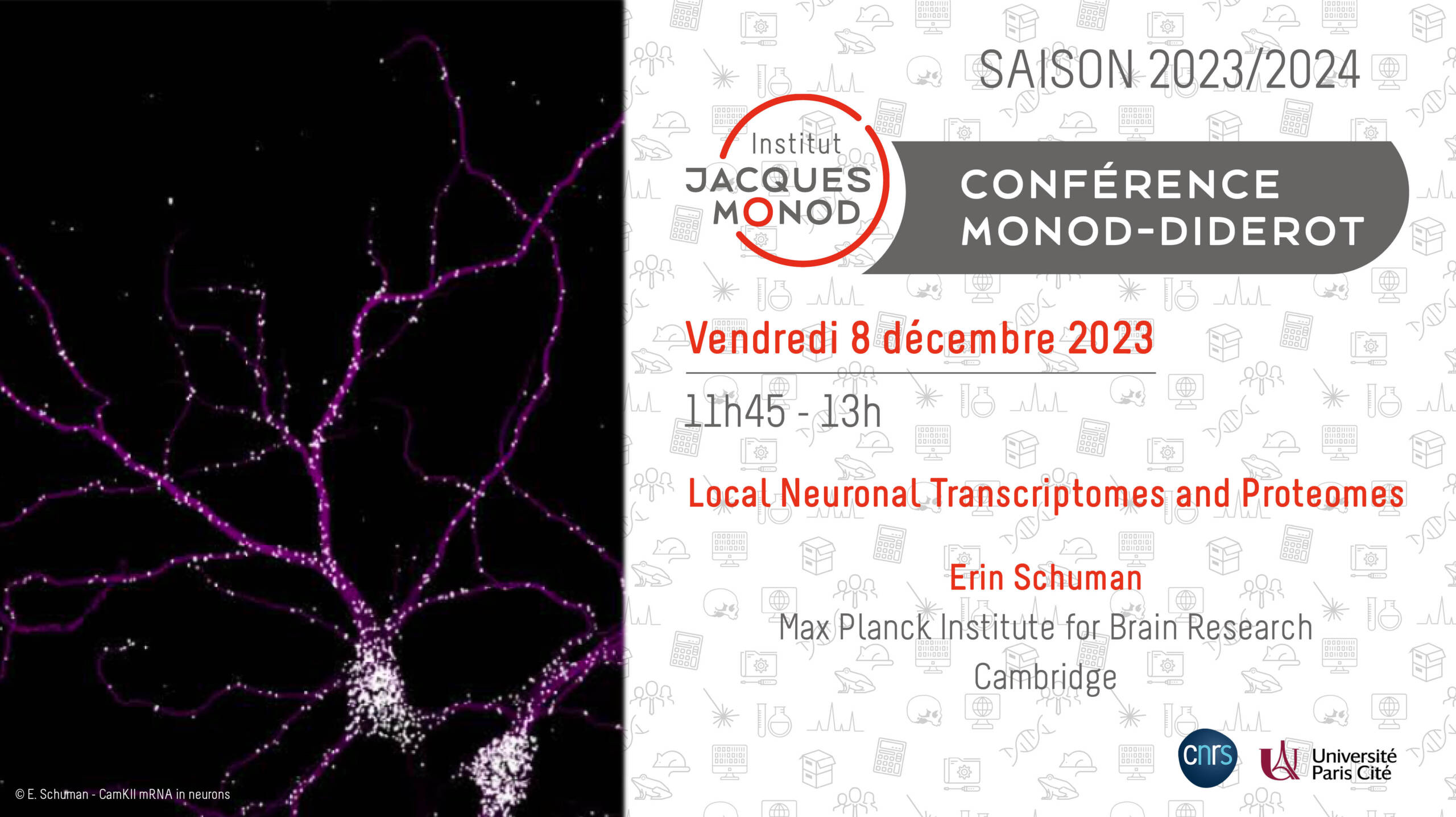
Le 8 décembre 2023, les conférences Monod-Diderot accueilleront Erin Schuman (Max Planck Institute for Brain Research) qui interviendra sur le thème :
Local Neuronal Transcriptomes and Proteomes
Résumé
"La morphologie complexe des neurones, avec des synapses situées à des centaines de microns du corps cellulaire, nécessite la localisation d'importantes machines et processus biologiques cellulaires dans les dendrites…
Invité par l'équipe Palancade, Alain Nicolas (Institut de Recherche sur le Cancer et le Vieillissement, Nice, France) va présenter un séminaire IJM sur le thème :
Mutators and mutational landscapes: from yeast to cancers
Résumé :
Genome sequencing in model organisms and tumors allowed the extraction of mutational landscapes. Our study of numerous S. cerevisiae mutator strains…
Symphosium on Fungal Genetics Ile de France 2023
Registration : here
The symposium seeks to
- Promote the exchange of ideas and results on fungal genetics topics pursued in the Paris region;
- Encourage the participation of young researchers (PhD students and post-docs);
- Address technical and scientific challenges faced by our fungal research community.
All the topics related to…
Le 17 novembre 2023, les conférences Monod-Diderot accueilleront Julian E. Sale (MRC Laboratory of Molecular Biology, Francis Crick Avenue, Cambridge) qui interviendra sur le thème :
Genomic determinants of mutation and epimutation
Résumé de la conférence :
"La capacité de certaines séquences d'ADN à former des structures secondaires signifie que l'ADN lui-même peut constituer l'un des obstacles…
We are pleased to announce the next DINGO (Dynamique-Instabilité Génétique et Oncogenèse) meeting on the 14-15 November 2023 at Institut Jacques Monod, Paris.
The meeting will cover:
Genetic Mechanisms shaping Immunotherapy Response
Aging, senescence and inflammation
RNA metabolism and genetic instability
Nuclear compartments and genome organization
Program : flyer
La prochaine réunion du Cytoskeleton club aura lieu mercredi 15 novembre à 9h30 à l'amphithéâtre Pierre-Gilles de Genne (Bâtiment Condorcet - 4 rue Elsa Morante).
Aurélie Bertin (chercheuse dans l'équipe Levy , Institut Curie) présentera "Cell-free study of curvature sensitive septins at the membrane: organization, reshaping and diffusion barrier"
Antony Lee (chercheur dans l'équipe Martin , Institut Curie) présentera…
L'équipe Grange/Geigl a publié un nouvel article dans Nature Ecology and Evolution :
Genome sequences of 36-37,000 year-old modern humans at Buran-Kaya III in Crimea
Deux génomes de 36-37 000 ans de Crimée éclairent les premières implantations réussies des Humains modernes en Europe et l’émergence du Gravettien
L’implantation des Humains en Eurasie après leur sortie d’Afrique fut un…
Invité par l'équipe Collignon, Josh Brickman (reNEW, Université de Copenhague) va présenter un séminaire IJM sur le thème :
The way we were - transcriptional foundations of plasticity in regulative development and differentiation
Résumé :
Plasticity in differentiation is the basis for the remarkable regulative properties of the early mammalian embryo and could underlie regeneration more broadly.…