Directrice de Recherche au CNRS et responsable de l’équipe « Régulation épigénétique de l’organisation du génome » à l’Institut Jacques Monod (CNRS / Université Paris Cité), Sandra Duharcourt est lauréate de la médaille d’argent 2022 du CNRS.
La médaille d’argent du CNRS distingue des chercheurs et des chercheuses pour l’originalité, la qualité et l’importance de leurs travaux, reconnus…
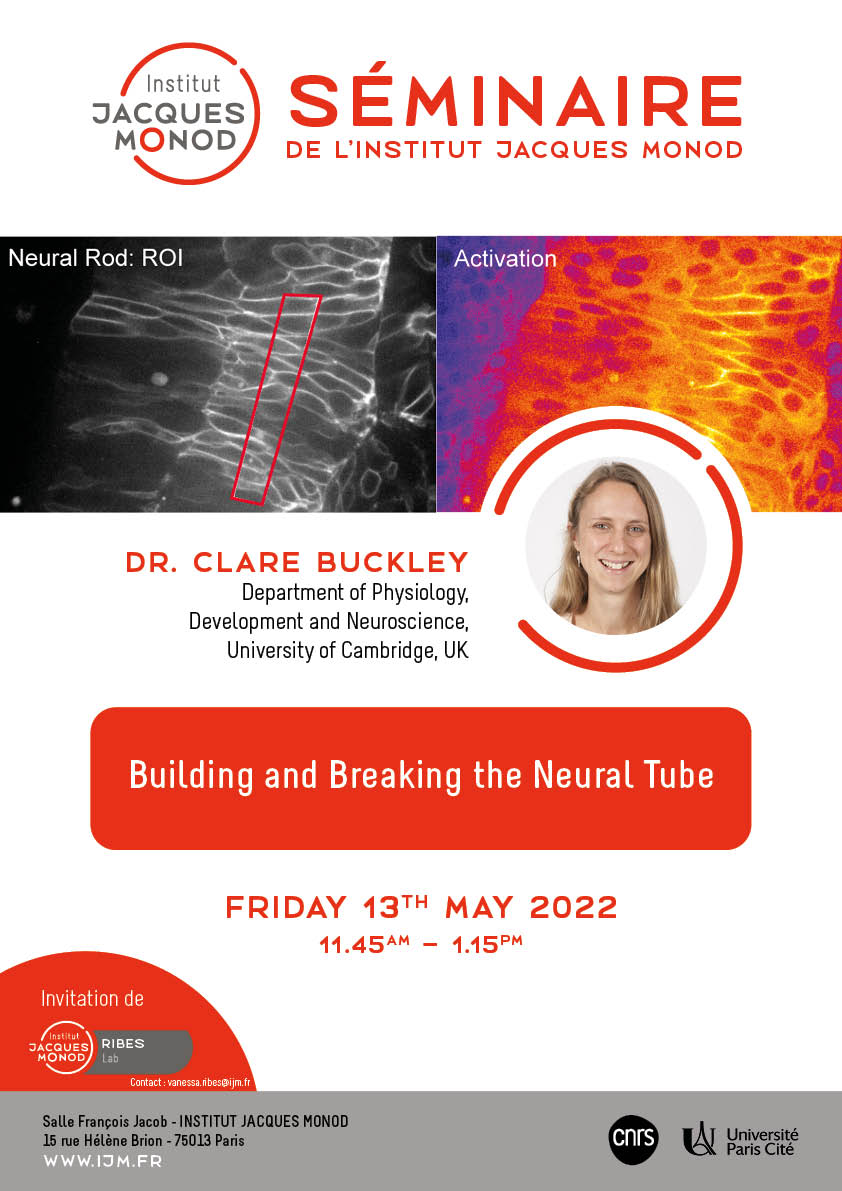
Invitée par Vanessa Ribes, Clare Buckley (Department of Physiology, Development and Neuroscience, University of Cambridge, UK) donnera le 13 mai en salle François Jacob un séminaire sur le thème :
Building and Breaking the Neural Tube
Her lab studies the fundamental cell biology of neural tube development using optogenetic and advanced live imaging approaches in vivo,…
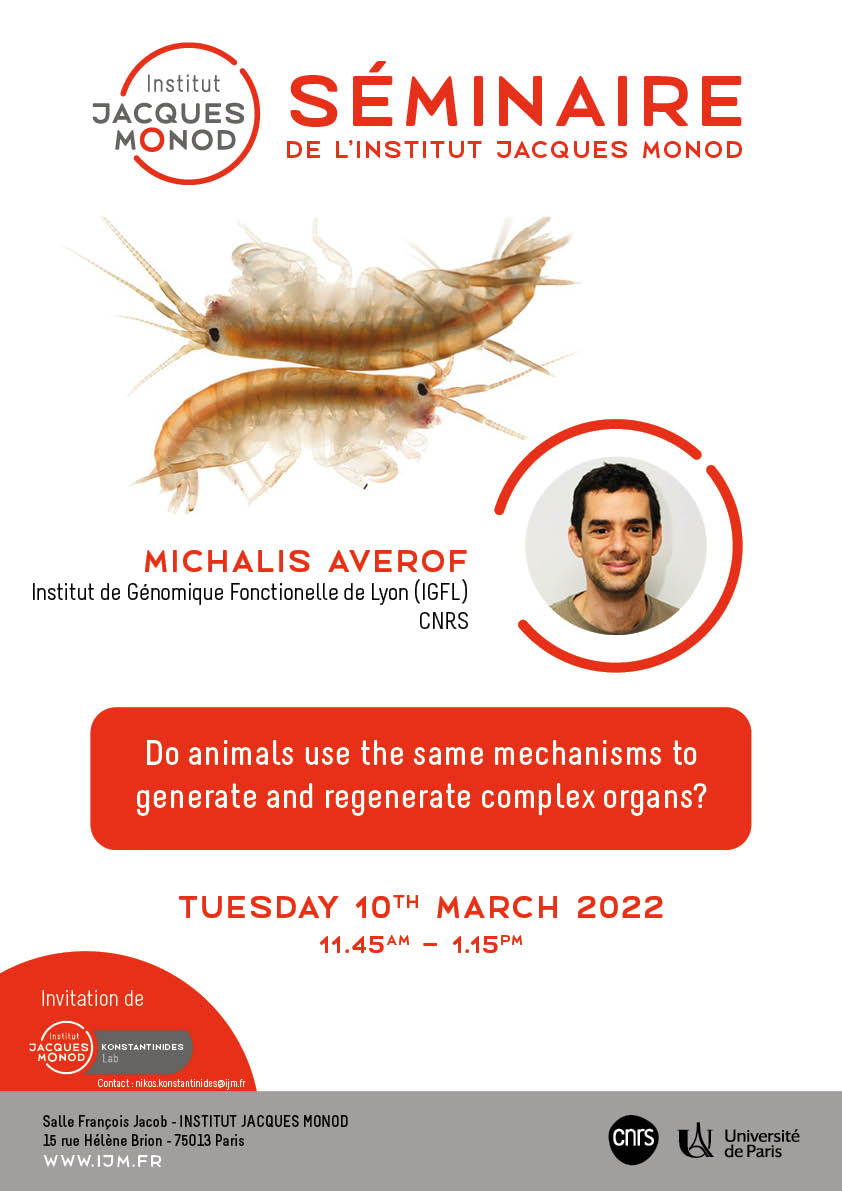
Michalis Averof (Institut de Génomique Fonctionelle de Lyon (IGFL) - CNRS) donnera un séminaire le 10 mai prochain à 11h45 en salle François Jacob :
Do animals use the same mechanisms to generate and regenerate complex organs?
Son équipe de recherche s'intéresse au développement embryonnaire et à la régénération, et elle compare ces processus dans divers animaux.
Est-ce que les mécanismes…
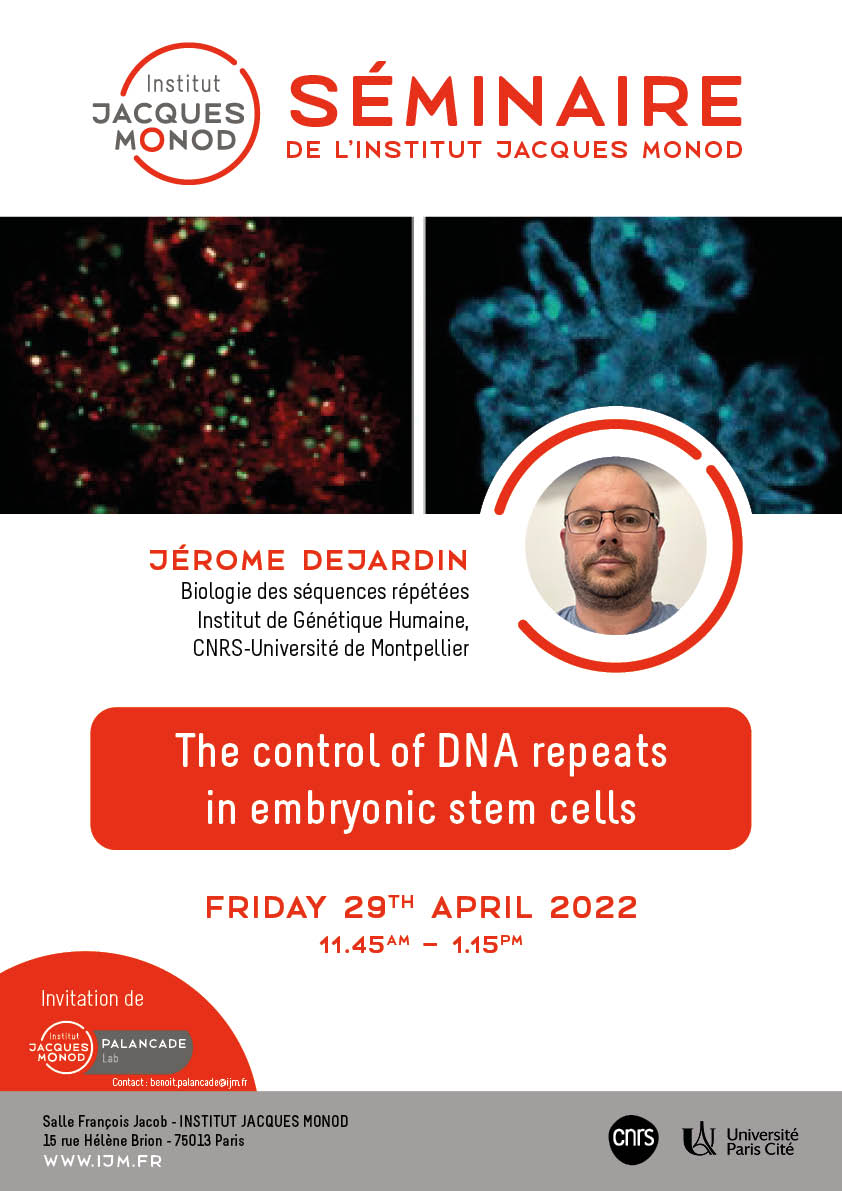
Invité par Benoit Palancade, Jérôme Déjardin (Biologie des séquences répétées, Institut de Génétique Humaine, CNRS-Université de Montpellier), donnera le 29 avril en salle François Jacob un séminaire sur le thème :
The control of DNA repeats in embryonic stem cells
Chromatin can be viewed as a highly complex mixture of proteins and nucleic acids that orchestrate…
Invité par Nikos Konstantinides, Isabel Almudi Cabrero (Department of genetics, microbiology and Statitics and IRBio , University of Barcelona) donnera le 22 avril en salle François Jacob un séminaire sur le thème :
Mayflies take off: a new evo-devo model to investigate insect evolution and the origin of new forms
Isabel is a Beatriz Galindo researcher…
Un nouvel article publié dans Nature par Nikos Konstantinides!
Félicitations à tous les auteurs !
A complete temporal transcription factor series in the fly visual system
Abstract
The brain consists of thousands of neuronal types that are generated by stem cells producing different neuronal types as they age. In Drosophila, this temporal patterning is driven by the successive expression…
Courtier Lab: Non-visual cues and indirect strategies that enable discrimination of asymmetric mates
Félicitations à Roshan Kumar Vijendravarma (Courtier Lab) pour ce nouvel article publié avec Pierre Leopold (Institut Curie) dans Ecology and Evolution:
Non-visual cues and indirect strategies that enable discrimination of asymmetric mates
Abstract
The postulates of developmental instability–sexual selection hypothesis is intensely debated among evolutionary biologists, wherein despite a large amount of empirical data, evidence for…
Un nouvel article publié par l'équipe Duharcourt dans Genome Research!
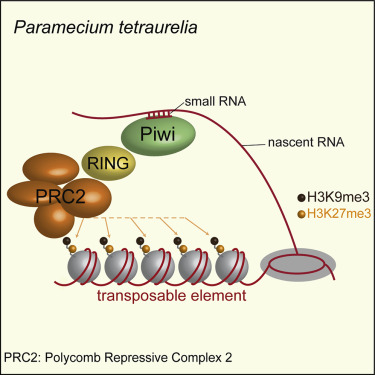
GC content, but not nucleosome positioning, directly contributes to intron splicing efficiency in Paramecium
Abstract
Eukaryotic genes are interrupted by introns that must be accurately spliced from mRNA precursors. With an average length of 25 nt, the more than 90,000 introns of Paramecium tetraurelia stand among the shortest…
The Monod-Diderot Lectures receive Claude Desplan (Silver Professor of Biology and Neuroscience, NYU Department of Biology, New York University) on 19 April 2022 at 11:45 am in the Buffon amphitheatre.
He will speak on the theme :
Spatial and temporal cues for the generation of neuronal diversity
Claude Desplan is a Silver Professor of Biology and Neuro-science…
Jean-Yves Tinevez (Image Analysis Hub / C2RI / Institut Pasteur, Paris) donnera un séminaire le 15 avril prochain à 11h45 en salle François Jacob :
Bioimage analysis platforms to track cells in large samples.
The Image Analysis Hub (IAH) of the Institut Pasteur is a core facility dedicated to service in Bioimage Analysis. Our mission is…