Skip to content Skip to footer

Ancienne équipe Camadro – Iron limitation promotes metabolic cross-feeding between cheese ripening bacteria

L'ancienne équipe Camadro a contribué à la publication d'un nouvel article dans The ISME Journal : Iron limitation promotes metabolic cross-feeding between cheese ripening bacteria Résumé : Iron is a limiting micronutrient in various environments, and its scarcity orchestrates microbial interactions across diverse ecosystems. The cheese surface, which is oxic, iron-limited, and a host of moderately complex…

Read More

Guichet Lab – Sexual Development in Fungi

L'équipe Guichet a contribué à la publication d'un chapitre de livre: Sexual Development in Fungi Résumé : This chapter explores the genetic and cellular mechanisms governing sexual reproduction in fungi, with a focus on Ascomycota and Basidiomycota. Sexual reproduction is orchestrated by the genetic regulation of mating identity, which ensures the recognition and differentiation of compatible partners.…

Read More

Dumont Lab – The interkinetic envelope: a discovery that challenges our knowledge of oocyte meiosis

L'équipe Dumont a publié un nouvel article dans médecine / science : The interkinetic envelope: a discovery that challenges our knowledge of oocyte meiosis   El Mossadeq L, Dumont J. L’enveloppe d’intercinèse - Une découverte qui bouscule notre connaissance de la méiose ovocytaire [The interkinetic envelope: a discovery that challenges our knowledge of oocyte meiosis]. Med Sci…

Read More

Duharcourt Lab – The tiny germline chromosomes of Paramecium aurelia have an exceptionally high recombination rate and are capped by a new class of Helitrons

L'équipe Duharcourt a publié un nouvel article dans BMC Biology : The tiny germline chromosomes of Paramecium aurelia have an exceptionally high recombination rate and are capped by a new class of Helitrons Background Paramecia belong to the ciliate phylum of unicellular eukaryotes characterized by nuclear dimorphism. A diploid germline micronucleus (MIC) transmits genetic information across sexual generations.…

Read More

Konstantinides Lab – Spatial, temporal and Notch determination of terminal selector expression controls neuronal cell fate in the Drosophila optic lobe

L'équipe Konstantinides a publié un nouvel article dans Nature neuroscience : Spatial, temporal and Notch determination of terminal selector expression controls neuronal cell fate in the Drosophila optic lobe Résumé : In the medulla of the Drosophila optic lobe, the identity of each neuronal type is specified in progenitors and newborn neurons via the integration of temporal, spatial and…

Read More

Prioleau Lab – Transcription at an inducible common fragile site reveals replication origin strength hierarchy

L'équipe Prioleau a publié un nouvel article dans Nucleic Acid Research : Transcription at an inducible common fragile site reveals replication origin strength hierarchy Résumé : While genome-wide analyses in vertebrates suggest that transcription negatively regulates replication origin activation, thereby shaping the landscape of replication initiation, it remains unknown whether efficient replication origins can overcome this suppression…

Read More

Gazave Lab – Multifaceted conserved functions of Notch during post-embryonic neurogenesis in the annelid Platynereis

L'équipe Gazave a publié un nouvel article dans EMBO reports : Multifaceted conserved functions of Notch during post-embryonic neurogenesis in the annelid Platynereis Résumé : Notch signaling is an evolutionarily conserved pathway known to orchestrate neurogenesis by regulating the transition from progenitors to neurons and glia, and by directing neurite outgrowth and axon guidance in many species. Although…

Read More

Duharcourt Lab – A H3K27me3 reader complex couples H3K27me3 accumulation to nascent transcription of transposable elements in Paramecium

L'équipe Duharcourt a publié un nouvel article dans Genome Biology : A H3K27me3 reader complex couples H3K27me3 accumulation to nascent transcription of transposable elements in Paramecium Résumé : Backgroud The ability to deposit histone H3K27-trimethyl (me3) marks is essential for transcriptional repression by Polycomb Repressive Complex 2 (PRC2). This is largely attributed to Polycomb repressive complex…

Read More

Wassmann Lab – Decoding Cdk1 control: from mitotic thresholds to meiotic specificity

L'équipe Wassmann a publié une review dans Chromosome Research : Decoding Cdk1 control: from mitotic thresholds to meiotic specificity Résumé : The eukaryotic cell cycle is one of the most fundamental biological processes, ensuring the accurate duplication and segregation of the genome during mitosis. Decades of research across model systems have shown that this process is orchestrated…

Read More

Romet-Lemonne / Jégou – Mechanisms of CARMIL dimerization, autoinhibition, and capping protein binding

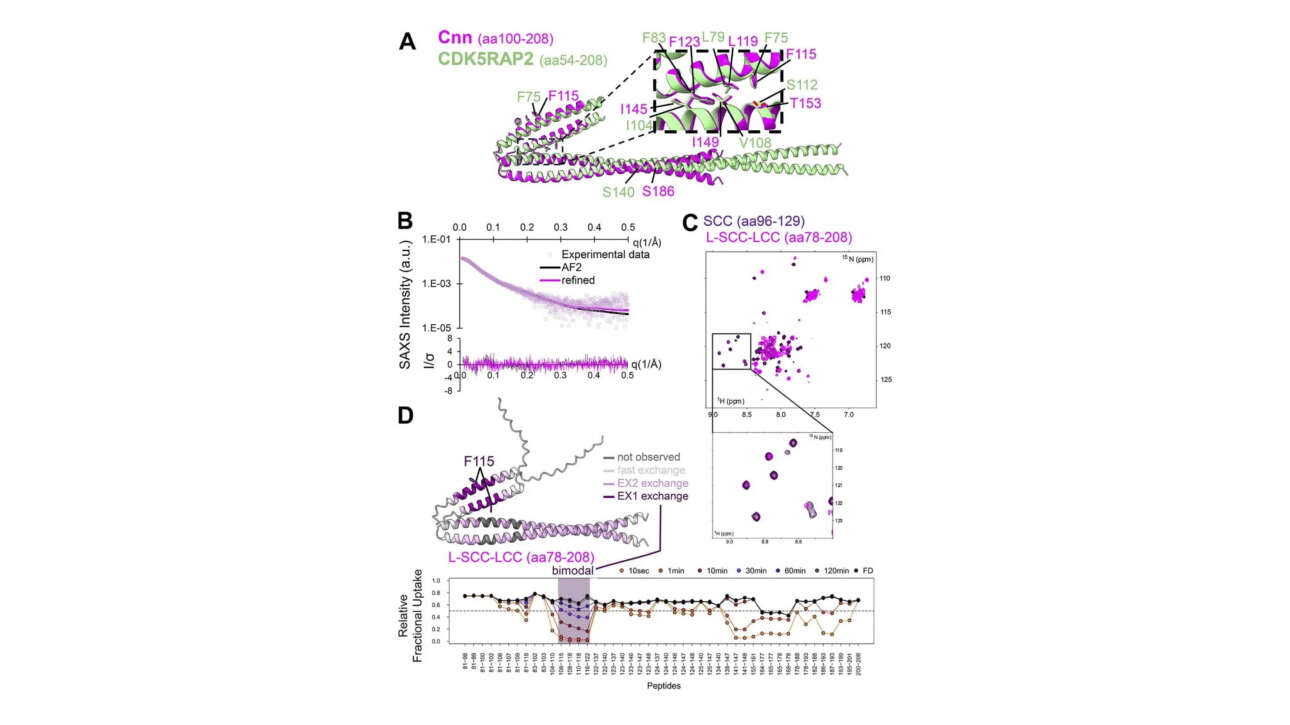
L'équipe Romet-Lemonne / Jégou a contribué à la publication d'un nouvel article dans Science Advances : Mechanisms of CARMIL dimerization, autoinhibition, and capping protein binding Résumé : Capping protein (CP) regulates actin-based motility by blocking monomer exchange at the filament barbed end. Several proteins, including CARMIL, bind CP and allosterically weaken its affinity for the barbed end.…

Read More