


Paris Postdoc Seminar – Alberto De La Iglesia
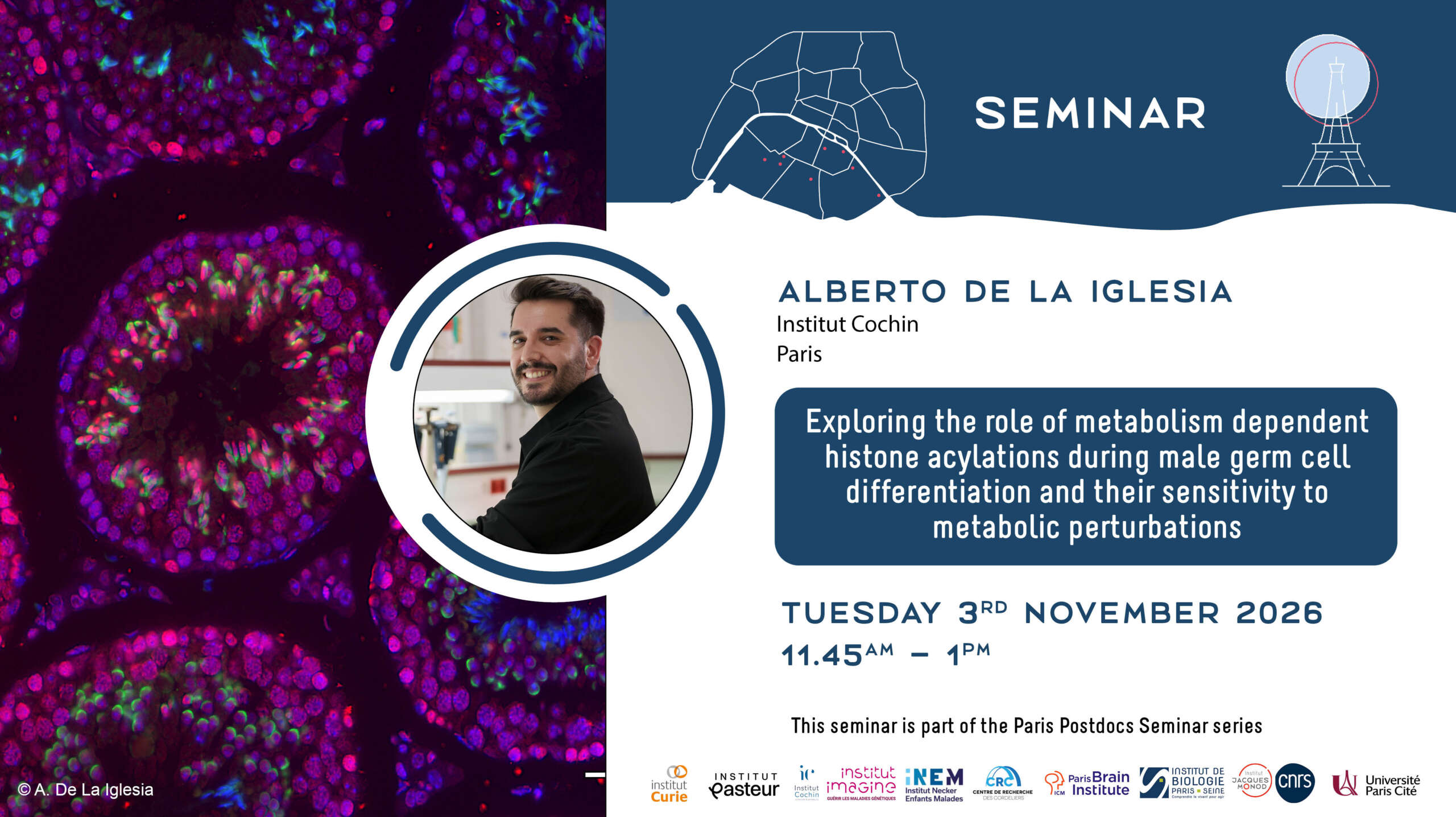
Invited by the Institut Jacques Monod, Alberto de la Iglesia, Ph.D. Institut Cochin (Inserm U1016 – CNRS UMR8104 – Université Paris Cité) Dr. Julie Cocquet Group “Epigenetics & Spermatogenesis”, part of the VAIMAN Team “From Gametes to Birth: Genomics, Epigenetics, and Physiopathology of Reproduction” will present a Paris Postdoc Seminar on te theme :
Exploring the role of metabolism-dependent histone acylations during male germ cell differentiation and their sensitivity to metabolic perturbations
Abstract:
The paternal epigenome is established during spermatogenesis and is particularly responsive to environmental cues. In line with the POHaD paradigm (Paternal Origins of Health and Disease), increasing evidence shows that environmentally induced paternal epigenetic alterations can have effects beyond fertilization, which is the case of paternal obesity. Within this context, our lab is interested in a type of epigenetic marks named histone acylations, whose abundance depends upon the availability of their precursor metabolites and, hence, are sensitive to the cell metabolic status.
To better understand the effects of a metabolic stress on coordinated metabolo-epigenetic signatures in male germ cells, we have established a mouse model of Western style diet-induced obesity (WD; high-fat/high-sugar, 16 weeks). WD males exhibited an altered testicular metabolome, characterized by metabolites involved in pathways related with energy metabolism and the generation of precursors of epigenetic marks. In parallel, we identified higher acetylation (ac) levels in male germ cells of WD mice, suggesting a link between the observed metabolomic and epigenetic alterations. Among other acylations, our lab has described that the recently identified histone lactylation (la) modifies several histone residues in the wild-type mouse testis (PMID 42285509). Unpublished CUT&Tag results revealed that H3K18la and H3K56la are mostly retained at the promoter of active genes and at distal regulatory regions. Besides, their different dynamics across spermatogenesis suggest distinct effects of both marks during the process. Ongoing multi-omics approaches in WD mice are currently being analyzed to study the sensitivity of Kla to metabolic changes in male germ cells.
Thus, our work supports that the testis can sense metabolic disturbances, leading to dysregulations in developing male germ cells at the metabolic and epigenetic levels. These alterations could be at the onset of the effects of male obesity beyond fertilization described in the POHaD framework.