


Institut Jacques Monod seminar – Idoia Quintana Urzainqui
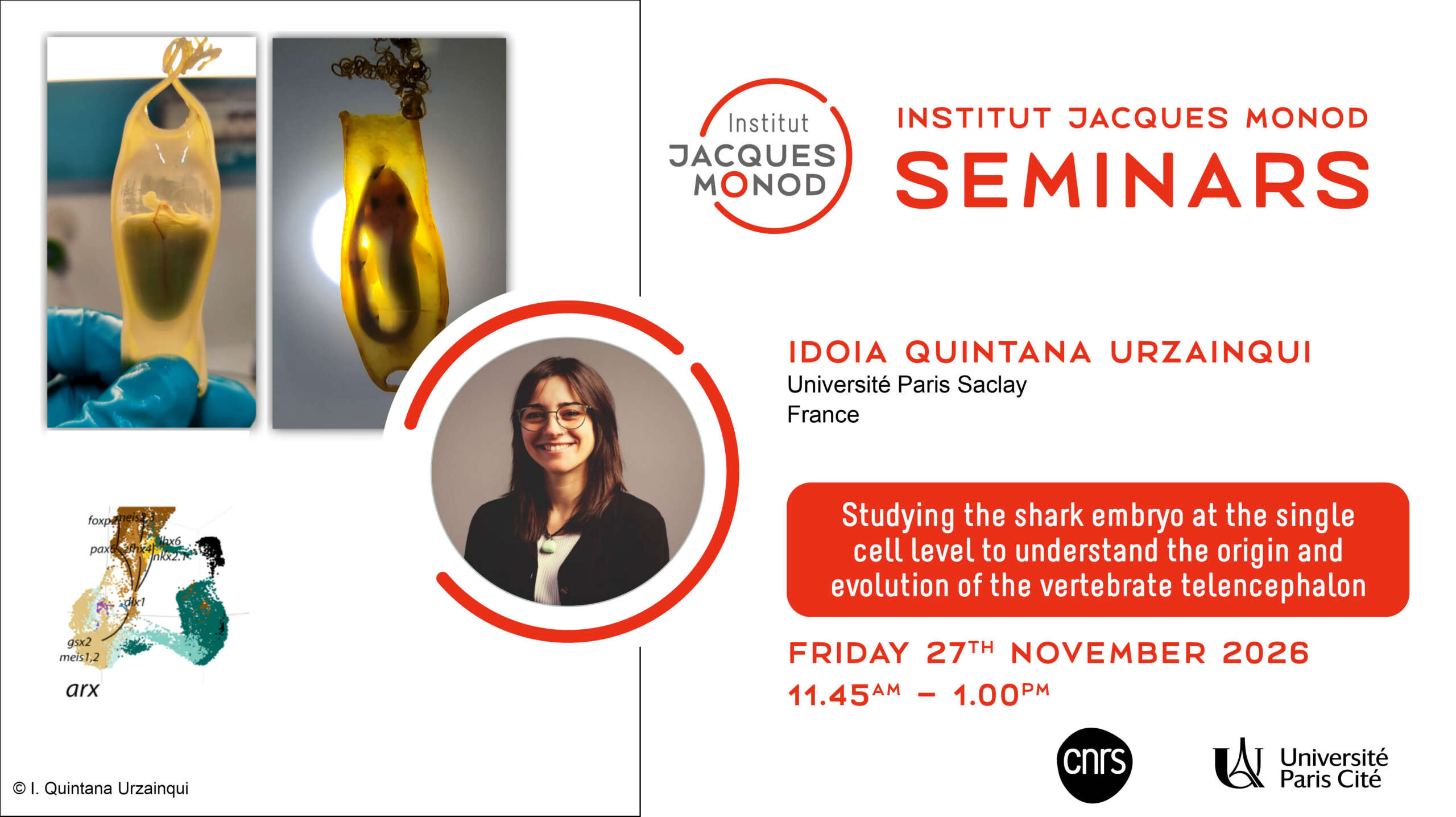
Invitéed by the Konstantinides lab, Idoia Quintana Urzainqui ( Université Paris Saclay, France) will present an Institut Jacques Monod seminar on the theme:
Studying the shark embryo at the single cell level to understand the origin and evolution of the vertebrate telencephalon
Abstract:
Much of what we know about vertebrate brain evolution comes from studying mammals. Cartilaginous fish, such as sharks, have been largely missing from this picture. They emerged around 450 million years ago, at a pivotal transition in vertebrate history: the shift from jawless to jawed vertebrates. Many new features appeared in these animals, including in the brain, probably linked to an increasingly complex lifestyle as active predators. Yet sharks have never been classic model organisms, as they have long been challenging to work with in the lab. As a result, there is a major gap in our knowledge: we still do not know which brain innovations truly emerged at that time, and we have virtually no understanding of how they arose at the molecular and cellular level. Working with catshark embryos, we found surprising similarities with mammals in brain development, including cell types such as basal progenitors and Cajal-Retzius cells, long thought to be mammalian or amniote innovations. These observations, made over only a short window of development, suggest that key features of the developing brain arose much earlier in vertebrate history than previously assumed. With my newly established group at NeuroPSI, we now aim to go beyond these first insights and reconstruct how the jawed vertebrate brain formed and diversified, combining single-cell and spatial multiomics, cross-species comparisons, developmental biology and gene editing in the shark. In this seminar, I will present the data that led to the establishment of the group, as well as the main lines of our recently awarded ERC project, EvoBrainShark.