


- Cet évènement est passé.
Séminaire de l’Institut Jacques Monod – Jennifer Young
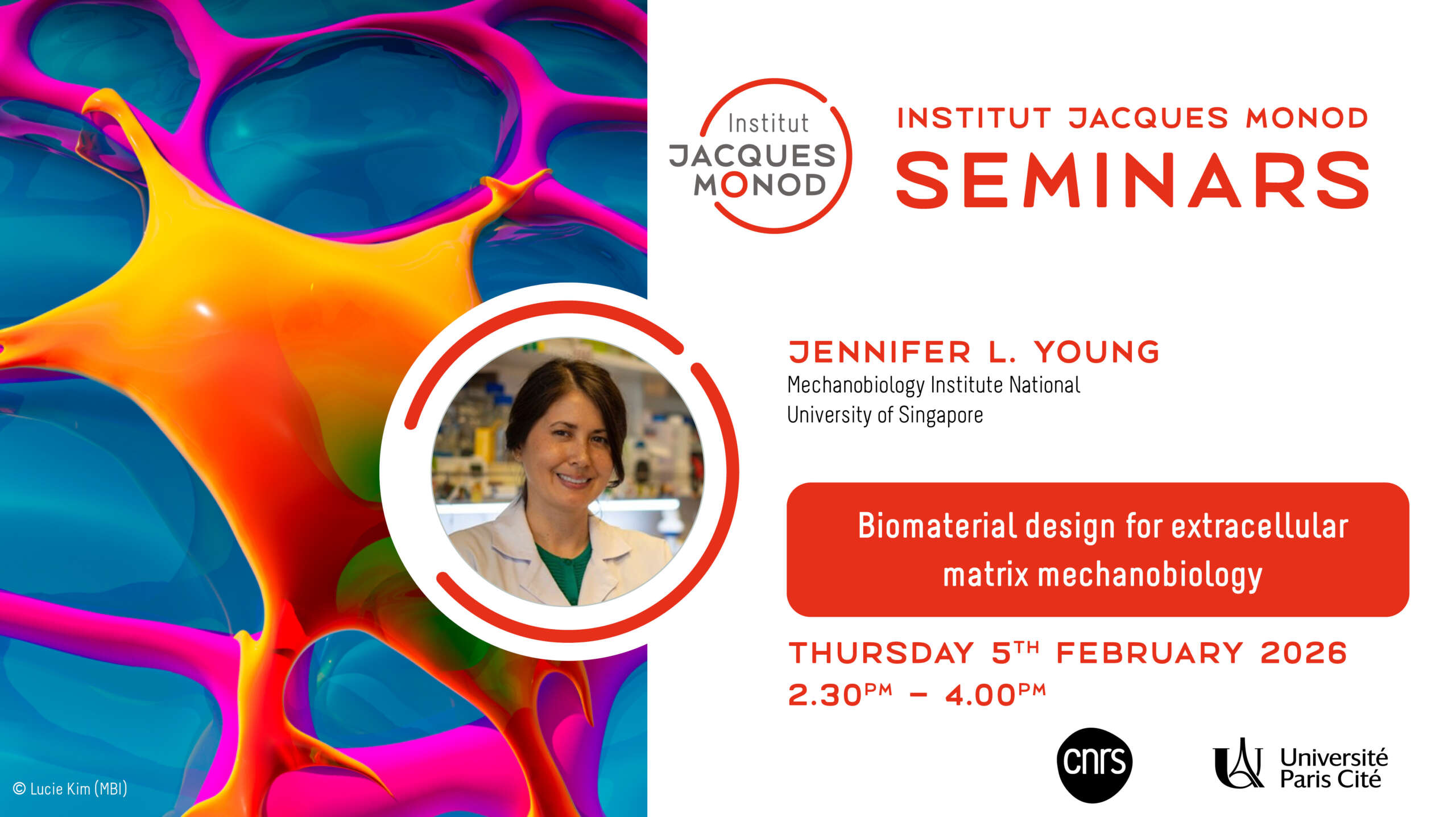
Invitée par l’équipe Ladoux/Mege, Jennifer Young (Assistant Professor, Biomedical Engineering Department, Principal Investigator, Mechanobiology Institute National University of Singapore) va présenter un séminaire de l’Institut Jacques Monod sur le thème :
Biomaterial design for extracellular matrix mechanobiology
Résumé :
Extracellular cues stemming from the matrix dictate a multitude of cellular functions, from motility to stem cell differentiation. Yet, the extracellular environment is inherently complex and thus hinders our understanding of specific matrix-based contributions to cellular behavior. Our work focuses specifically on the context of age-related matrix remodeling and engineering materials capable of recapitulating matrix properties in vitro at both the micro and nano length scales. This talk will highlight some of our material approaches to control cell-matrix interactions in the context of aging and mechanobiology. Our strategies ultimately aim to interrogate the cell-matrix interface using highly defined biomaterial systems that can inform future matrix-based treatment strategies.
Jennifer Young was trained as a biomedical engineer at the University of California, San Diego (La Jolla, CA, USA). During her Ph.D. with Prof. Adam Engler, she studied the role of mechanics in cardiac development and created a hydrogel system capable of mimicking dynamic tissue properties in vitro. Inspired by the role of extracellular matrix (ECM) in dictating cell behavior and fate, she joined the Cellular Biophysics group of Prof. Joachim Spatz at the Max Planck Institute for Medical Research (Heidelberg, Germany) to study how nanoscale ECM cues regulate cancer cell function. She established the Soft Nano-Biomaterials Lab in 2021 at the Mechanobiology Institute and Biomedical Engineering Department, National University of Singapore where her work focuses on identifying and mimicking nano-to-microscale matrix properties and unraveling their contributions to cellular behavior.