


- Cet évènement est passé.
Séminaire de l’Institut Jacques Monod – Christian Schlieker
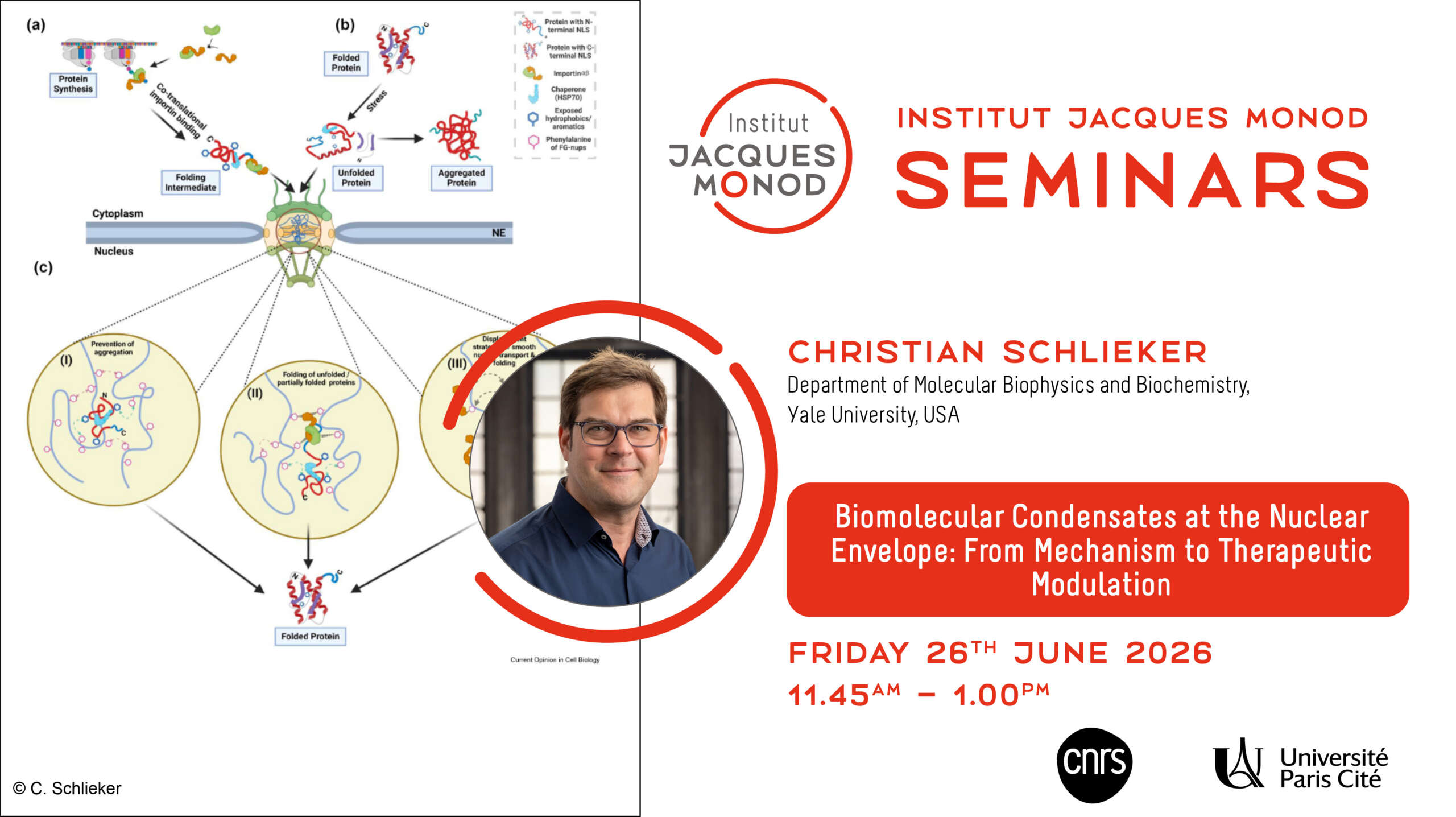
Invité par l’équipe Palancade, Christian Schlieker (Department of Molecular Biophysics and Biochemistry, Yale University, USA) présentera un séminaire de l’Institut Jacques Monod sur le thème :
Biomolecular Condensates at the Nuclear Envelope: From Mechanism to Therapeutic Modulation
Christian started his scientific training as an undergraduate at the University of Bonn in Germany, with a research stay at the University of New South Wales in Sydney, Australia. He then earned his Ph.D. in the laboratory of Dr. Bernd Bukau at the Center for Molecular Biology (ZMBH) of Heidelberg University, where he used biochemical and biophysical approaches to uncover how Clp/HSP100 AAA+ ATPases counteract proteotoxic stress.
Christian continued his training as an EMBO postdoctoral fellow with Dr. Hidde Ploegh at Harvard Medical School and the Whitehead Institute/MIT, where he explored the ubiquitin–proteasome system and discovered a novel role for a ubiquitin-like modifier in RNA biology.
Christian joined the Department of Molecular Biophysics and Biochemistry at Yale University in 2009, where he is currently Professor and Director of Undergraduate Studies, with a secondary appointment in the Department of Cell Biology. He is a recipient of the NIH Director’s New Innovator Award and has served on the scientific advisory board of the Dystonia Medical Research Foundation and reviewed for the NIH, the Department of Defense, the German Excellence Initiative, ANR and the European Research Council, among others. At Yale, he has chaired the Committee on Majors for Yale College and currently serves on the Advisory Board of the Yale Center for Molecular Discovery. Starting in July 2026, he will chair the Department of Molecular Biophysics and Biochemistry.
Brief synopsis
We explore how cells build and safeguard two the nuclear envelope and the endoplasmic reticulum. Our work focuses on how disruptions in membrane organization and phase separation drive the formation of aberrant condensates that are increasingly implicated in neurological disease. To tackle these questions, we develop and apply new tools that allow us to probe and modulate these processes across scales, from the dynamics of individual proteins and condensates to genome-wide functional screens. By integrating cell biology, biochemistry, and computational approaches with patient-derived and animal model systems, we aim to uncover fundamental principles of cellular organization and translate these discoveries into novel therapeutic strategies for movement disorders and related conditions.
We recently developed a high-content platform and computational pipeline to screen modulators of nuclear condensates across chemical and genetic space. This effort identified novel players in nuclear condensates formation, along with small molecules that modualte proteotoxic condensates. Application of the platform in a genome-wide CRISPR knockout screen revealed strong enrichment of candidate genes linked to primary microcephaly and related neurodevelopmental disorders, pointing to condensate dysregulation as a shared molecular axis across disease.
A complementary line of work asks how the nuclear pore complex itself contributes to protein quality control. Co-translational folding allows nascent proteins to begin folding as they are synthesized, reducing the risk of aggregation and avoiding energy-intensive unfolding steps. We propose that karyopherins and flexible FG-nucleoporins not only safeguard the nuclear permeability barrier but also generate a supportive environment — a “folding phase” — that promotes correct folding of proteins entering the nucleus. This perspective offers new insight into how disruptions in nuclear transport and protein quality control may contribute to neurological disease. Together, these efforts may inform biotechnological advances in protein stability and targeted therapeutics for diseases of disrupted folding.
Selected publications
- Prophet SM, Rampello AJ, Niescier RF, Gentile JE, Mallik S, Koleske AJ, Schlieker C: Atypical nuclear envelope condensates linked to neurological disorders reveal nucleoporin-directed chaperone activities. Nat Cell Biol 2022, 24:1630–1641.
- Poch D, Mukherjee C, Mallik S, Todorow V, Kuiper EFE, Dhingra N, Surovtseva YV, Schlieker C: Integrative Chemical Genetics Platform Identifies Condensate Modulators Linked to Neurological Disorders. bioRxiv 2025, doi:10.1101/2025.06.07.658469.
- Rampello AJ, Laudermilch E, Vishnoi N, Prophet SM, Shao L, Zhao C, Lusk CP, Schlieker C: Torsin ATPase deficiency leads to defects in nuclear pore biogenesis and sequestration of MLF2. J Cell Biol 2020, 219:e201910185.
- Mallik S, Poch D, Burick S, Schlieker C: Protein folding and quality control during nuclear transport. Curr Opin Cell Biol 2024, 90:102407.