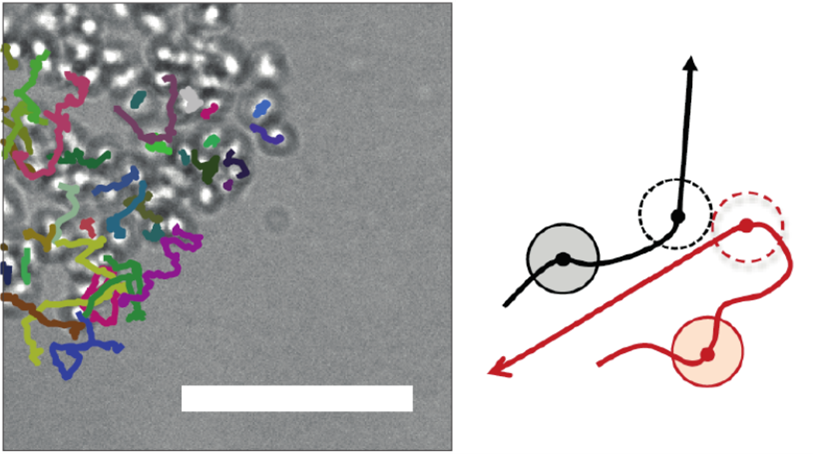


In several contexts in the lifetime of pluricellular organisms, and also in some “social” unicellular organisms, cells move, individually or collectively, in a more or less coordinated fashion. I am especially interested in the class of eukaryotic cells called “adhering” or “mesenchymal” cells. They self-propel using asymmetric – polarised – polymerisation and contraction of their actin cytoskeleton. Thus they can be viewed as a specific instance of polar active particles.
I study the regulation of this polarity at various levels:
- Cell polarity dynamics: cell polarity is not a unique, stably defined object. Rather is it a collection of asymmetries that emerges from the coupling of different cell components. In particular, I study how cell extremities define themselves as “front” and “rear”, not only through their spontaneous protrusive activity, but also through their reciprocal interaction.
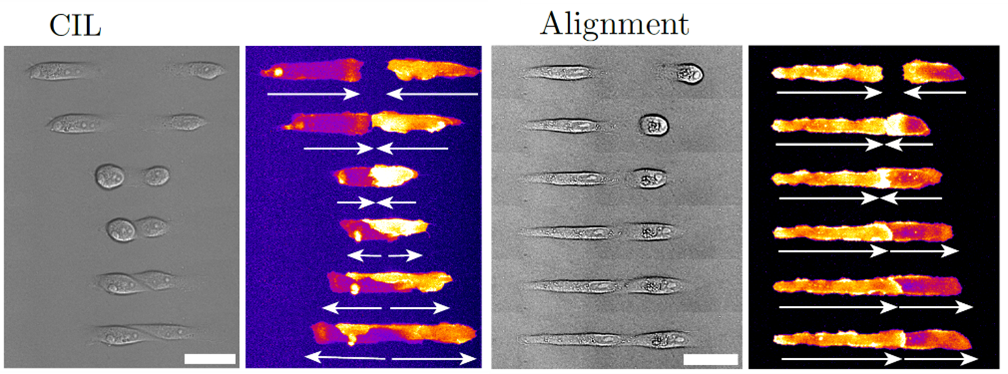
- Contact interactions and collective motion : I explore the hypothesis that collective motion of epithelial monolayers essentially stems from local, neighbouring cells interactions. In that framework, I am asking the following question: how do “CIL” (Contact Interaction of Locomotion, a polarity-repelling effect) and “CFL” (Contact Following of Locomotion, a trend of cells to follow each other) combine to give rise to coordinated motion of cell pairs, clusters and monolayers?
- Cell footprint : cells modify their substrate by depositing a “footprint” on their way, which in turn changes their motion – they tend to trace back their steps and stay on the footprint. I study the effects of footprint on cell polarity, both at cellular and collective scale.
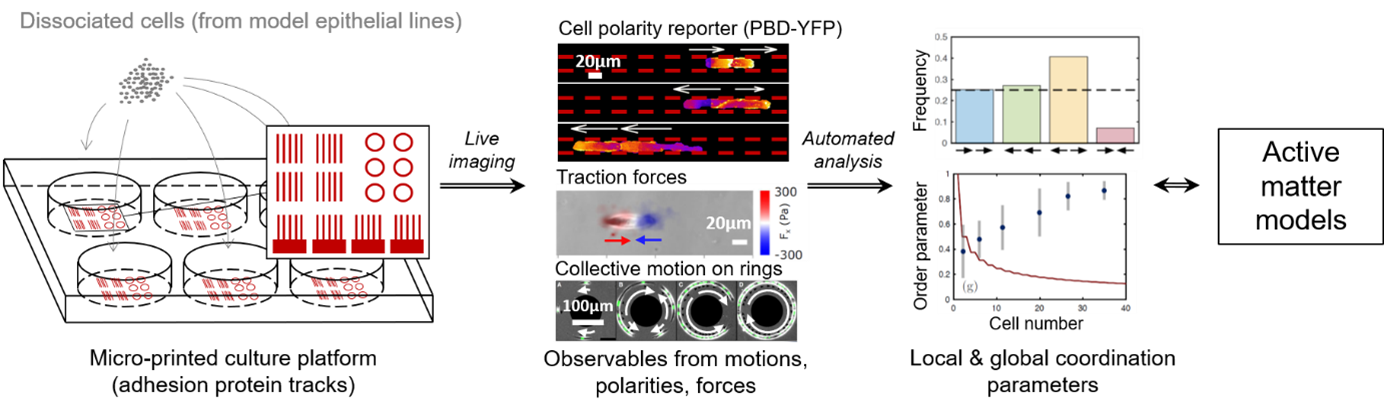
To address those questions, I perform cell migration experiments under controlled geometries. I make use of epithelial cell lines, seeded on micro-patterned substrates, so that their motion is confined, most of the time along quasi-1d tracks. This way, I can more easily define observables to characterise overall or internal dynamics of cells (such as their edges’ trajectory, protein activity fields, forces exerted on the substrate) and relate them to active-matter-physics-based descriptions.
Sélection de publications
- Epithelial collective cell migration explained by pair cell-cell interactions: Bertrand et al. Clustering and ordering in cell assemblies with generic asymmetric aligning interactions. Phys. Rev. Res. 6, 023022 (2023).
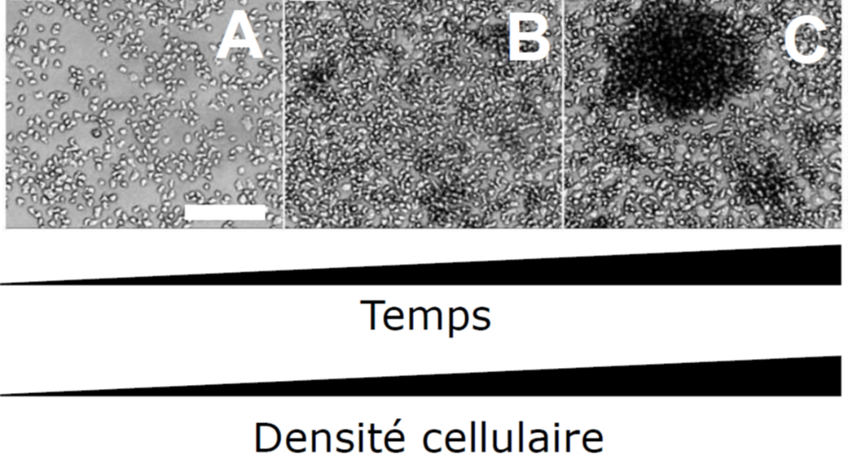
- Gas » and « droplets » of Dictyostelium cells:Carrère et al. Microphase separation of living cells. Nat. Commun.14, 796 (2023).
- Epithelial cells behave as self-attracting random walkers: d’Alessandro et al. Nat. Commun. 12, 4118 (2021).
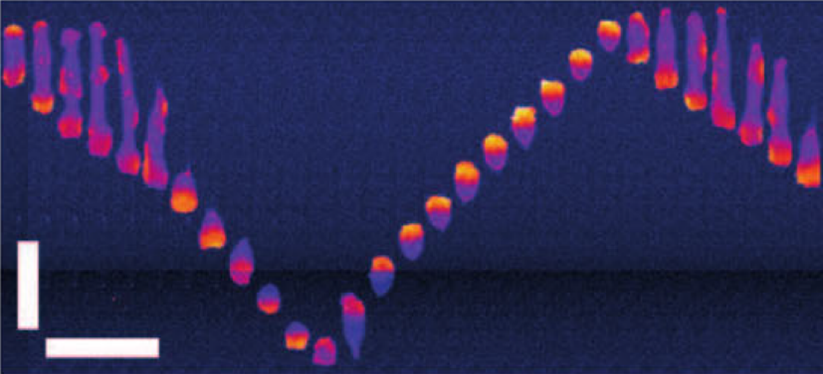
- Keratinocyte monolayers behave as polar active solids: Peyret et al. Sustained oscillations of epithelial cell sheets. Biophys. J. 117 464–478 (2019).
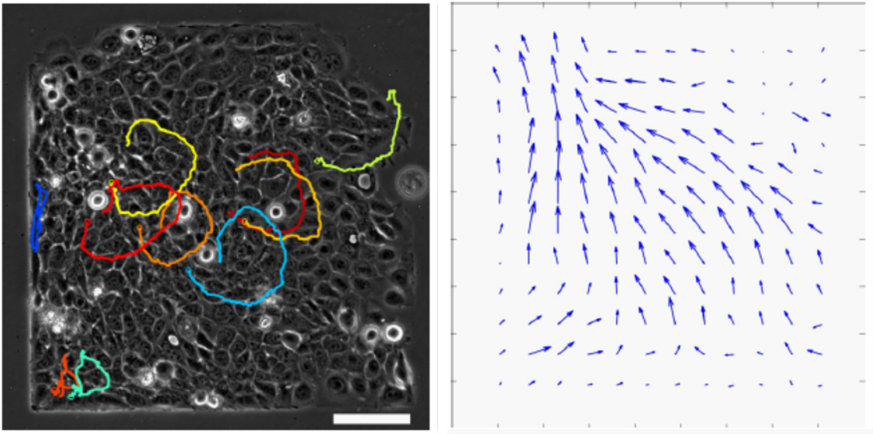
- An internal memory of cell-cell collisions accelerates the spreading of Dictyostelium cell colonies: d’Alessandro et al. Contact enhancement of locomotion in spreading cell colonies. Nat. Phys. 13, 999–1005 (2017).